When Tax Compliance Becomes a Double Burden: The Forgotten Plight of Short-Term Overseas Employees
The Problem Nobody Talks About
Imagine an Indian individual who gets an opportunity to work abroad for a few months.
He travels overseas, works for five or six months, earns a salary and pays income tax in that country. After completing the assignment, he returns to India and resumes his normal life.
At the time of filing his Indian income-tax return, he may not fully understand the complexities of international taxation.
He may believe that since tax has already been deducted from his salary abroad, there is nothing further to report in India. Alternatively, he may simply be unaware of the requirement to disclose foreign income and claim Foreign Tax Credit (FTC).
The return is filed, the financial year passes and life moves on.
Four or five years later, he discovers that the foreign salary should have been properly reported in India and that the corresponding foreign tax credit should have been claimed in accordance with the applicable provisions.
But by then, the situation may have changed completely.
The time limits for filing a revised return or an updated return may have expired.
What was once an innocent compliance omission can now become a substantial financial problem.
Understanding the DTAA and Foreign Tax Credit
India has entered into Double Taxation Avoidance Agreements (DTAAs) with several countries to provide relief from double taxation.
The underlying objective is straightforward: the same income should not suffer inappropriate double taxation merely because it has a connection with two countries.
Under the Foreign Tax Credit framework, an eligible Indian tax resident can claim credit for qualifying foreign taxes paid on income that is also offered to tax or assessed in India, subject to the applicable DTAA and prescribed conditions.
The credit is generally restricted to the lower of the eligible foreign tax and the Indian tax attributable to that income.
The purpose of this mechanism is to provide relief where the same income is taxable in both jurisdictions.
However, claiming this benefit requires compliance with prescribed reporting and documentation requirements.
When Procedural Time Limits Become a Problem
Under the earlier Income-tax Act, 1961, Rule 128 of the Income-tax Rules, 1962 dealt with Foreign Tax Credit.
Form 67 was prescribed for reporting foreign income and the corresponding foreign tax credit.
The rules also prescribed timelines for furnishing Form 67.
An important development was the amendment allowing Form 67 to be furnished by the date of filing an eligible updated return under Section 139(8A).
However, an updated return is itself subject to a statutory time limit.
From 1 April 2025, the updated return window was extended to 48 months from the end of the relevant assessment year.
The Income-tax Act, 2025, effective from 1 April 2026, continues the 48-month framework under Section 263(6), subject to the applicable conditions.
Therefore, where the relevant statutory window has expired, the taxpayer may find it difficult to correct the original omission and obtain the corresponding foreign tax credit through the normal return-filing mechanism.
The problem is particularly acute for individuals whose overseas employment was for a very short period several years ago.
The Human Side of Tax Compliance
It is important to distinguish between deliberate tax evasion and an honest compliance mistake.
Consider two situations:
Situation 1: Deliberate concealment
A taxpayer knowingly conceals foreign income despite understanding the reporting requirements and intentionally avoids paying tax.
Situation 2: Genuine ignorance
An ordinary salaried individual works abroad for five or six months, pays tax in the foreign country, returns to India and fails to report the income due to a lack of awareness of the Indian tax provisions.
Should both situations be approached in exactly the same manner?
Tax laws must protect revenue and discourage non-compliance. But tax administration must also recognise the difference between deliberate concealment and genuine ignorance.
A person who has already paid tax overseas and has documentary evidence of that payment should have a reasonable opportunity to establish the facts and seek the relief legally available under the applicable DTAA.
A Practical Recommendation to the Government
The Government should consider introducing a One-Time Foreign Tax Credit Relief Scheme for genuine individual taxpayers whose foreign employment income relates to earlier years and whose normal return-correction windows have expired.
The proposed relief mechanism could have the following features:
- Limited eligibility: The scheme should cover genuine individual taxpayers who earned salary from short-term overseas employment.
- Proof of foreign tax payment: The taxpayer should produce foreign salary statements, tax deduction certificates, tax returns or tax payment receipts, as applicable.
- Verification of Indian tax liability: The Income Tax Department should verify the taxpayer's residential status, the nature of foreign income and the corresponding Indian tax liability.
- DTAA-based relief: Credit should be allowed only to the extent legally admissible under the relevant DTAA or applicable provisions for relief from double taxation.
- Safeguards against misuse: The scheme should exclude deliberate concealment, fraudulent claims and cases where the law specifically prohibits such relief.
- A defined application window: Taxpayers should be given a reasonable, one-time opportunity to submit supporting documents and regularise genuine past omissions.
Such a mechanism would not amount to a general tax amnesty. It would simply provide a limited opportunity to genuine taxpayers to establish their eligibility for relief against double taxation.
The Larger Question: Is Procedural Compliance More Important Than Substantive Relief?
Tax compliance is essential. Filing returns correctly, reporting foreign income and furnishing Form 67 within the prescribed time are important responsibilities.
At the same time, the objective of a DTAA is to provide relief from double taxation.
When an individual has actually paid tax in another country, the question deserves consideration: should a genuine procedural lapse, discovered several years later, permanently deprive that person of an otherwise legitimate claim to relief?
There may be practical difficulties in verifying old foreign tax records. There may also be concerns about misuse. These are valid considerations, but they can be addressed through documentation, verification and reasonable safeguards.
A fair tax system should encourage voluntary compliance and provide proportionate remedies for genuine mistakes.
Final Thought
Tax administration should not become a punishment for ignorance when there was no intention to evade tax.
An individual who worked abroad for a few months, paid tax there and returned to India should not be left without a practical remedy merely because he did not understand the complexities of international taxation at the time.
The Government has an opportunity to address this genuine hardship through a carefully designed one-time relief mechanism.
After all, the objective of a Double Taxation Avoidance Agreement is not merely to exist on paper. It is to provide meaningful relief to eligible taxpayers.
A fair tax system must protect revenue, but it must also protect the genuine taxpayer.
#IncomeTax #DTAA #ForeignTaxCredit #DoubleTaxation #TaxpayerRights #FinanceAct2026 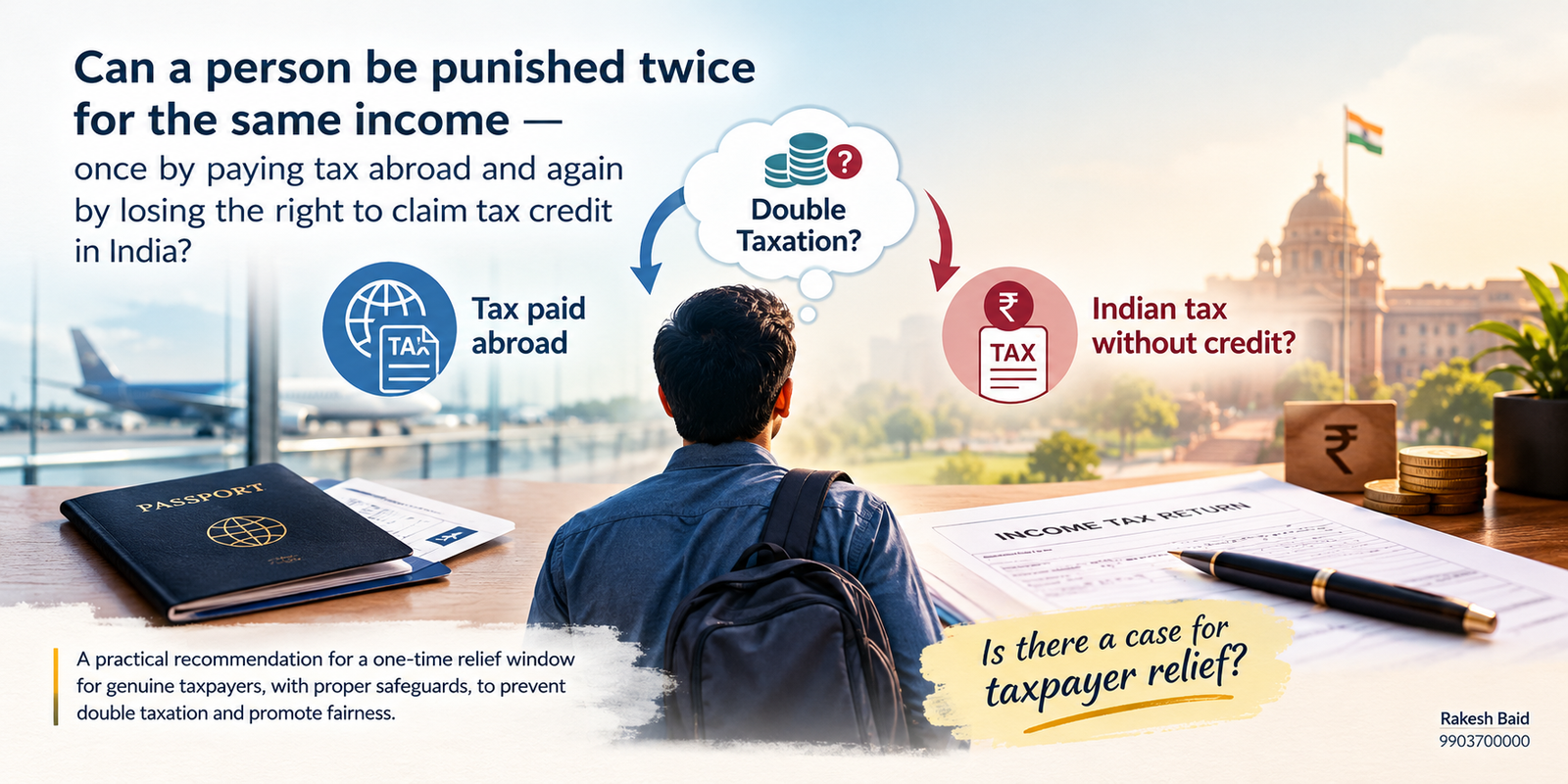 #FAST-DS 2026