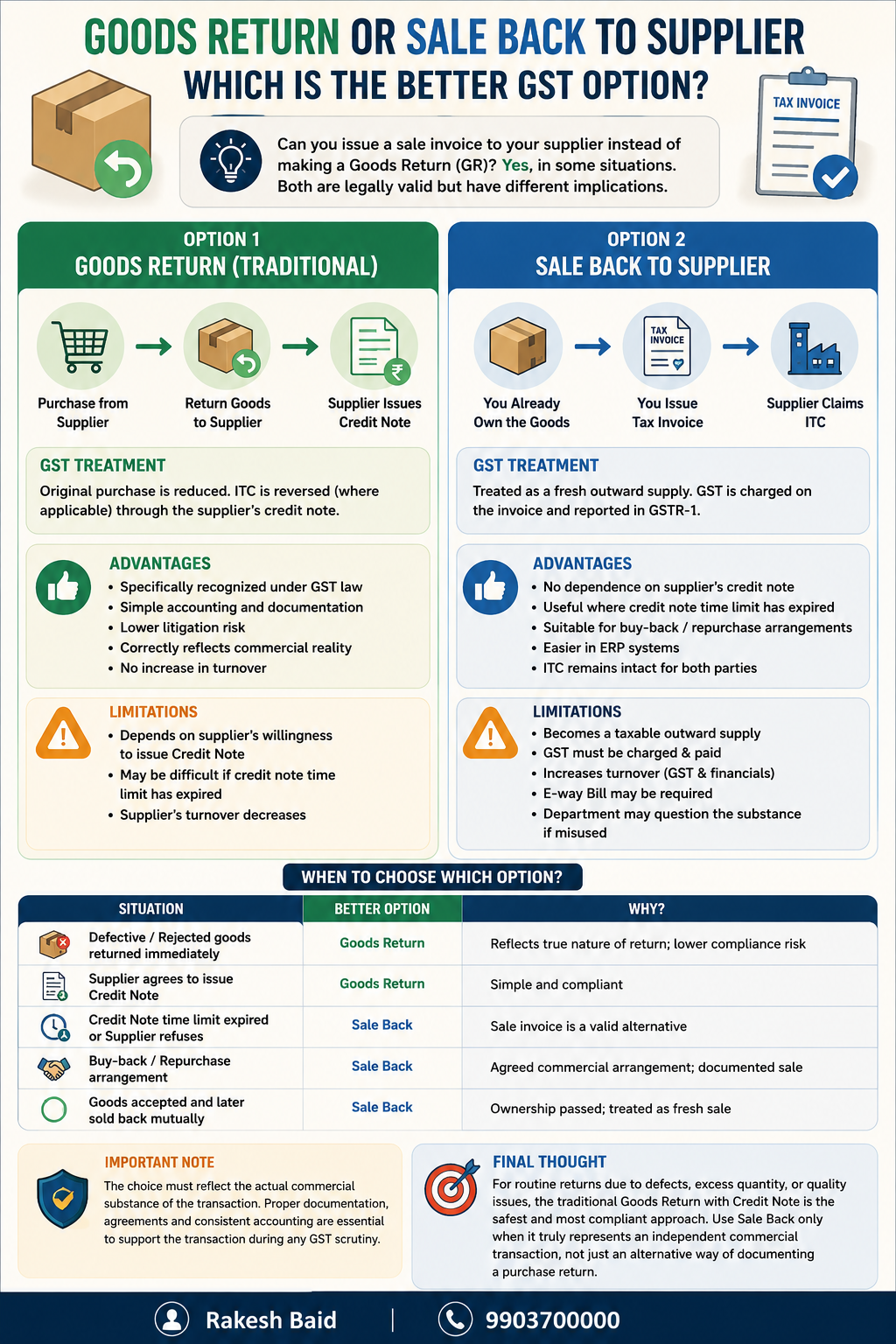
Goods Return or Sale Back to Supplier – Which is the Better GST Option?
Understanding the Two Approaches
When goods purchased from a supplier need to be sent back due to defects, excess quantity, or quality issues, businesses generally follow the traditional Goods Return process. In this method, the supplier issues a credit note, reducing the original transaction.
An alternative approach is to issue a tax invoice and sell the goods back to the supplier. Although this may appear unconventional, GST law does not prohibit it, provided the transaction is a genuine sale and not merely a disguised purchase return.
Option 1: Goods Return (Traditional Method)
Under this method:
- Goods are returned to the supplier.
- The supplier issues a Credit Note.
- The original purchase value is reduced.
- Input Tax Credit (ITC) is adjusted as per GST provisions.
Advantages
- Specifically recognized under GST law.
- Simple accounting and documentation.
- Lower litigation risk.
- Correctly reflects the commercial reality of a purchase return.
- No increase in turnover.
Limitations
- Depends on the supplier issuing a Credit Note.
- May become difficult if the statutory time limit for issuing a GST Credit Note has expired.
- Some suppliers may refuse to issue a Credit Note due to accounting or commercial reasons.
Option 2: Sale Back to the Supplier
If ownership of the goods has already passed to the buyer, the buyer is free to sell those goods to anyone—including the original supplier.
In such cases:
- A regular Tax Invoice is issued.
- GST is charged on the sale.
- The supplier can claim Input Tax Credit on the purchase.
- The transaction is treated as a fresh outward supply.
Advantages
- No dependence on the supplier issuing a Credit Note.
- Useful where the Credit Note time limit has expired.
- Suitable for contractual buy-back or repurchase arrangements.
- Often easier to manage in ERP systems that treat purchase returns differently.
Limitations
- Becomes a taxable outward supply.
- GST must be charged and reported in GSTR-1.
- Output tax becomes payable.
- Increases turnover for GST and financial reporting purposes.
- May require an e-Way Bill, wherever applicable.
- If used merely to avoid the Goods Return process, the department may question the true nature of the transaction.
When Should You Choose Which Option?
| SituationRecommended Approach | |
| Defective or rejected goods returned immediately | Goods Return |
| Supplier agrees to issue Credit Note | Goods Return |
| Supplier refuses to issue Credit Note | Sale Back (subject to proper documentation) |
| Buy-back arrangement under a commercial agreement | Sale Back |
| Goods accepted and later sold back by mutual agreement | Sale Back |
A Word of Caution
The choice should always reflect the actual commercial substance of the transaction.
If ownership of the goods never passed to the buyer, issuing a sale invoice may not be appropriate. On the other hand, where the buyer has legally acquired ownership and subsequently decides to sell the goods back to the supplier under a separate commercial arrangement, issuing a tax invoice is generally a valid approach.
Proper documentation, commercial agreements, and consistency in accounting treatment are essential to defend the transaction during any GST scrutiny.
Final Thought
While issuing a sale invoice to the supplier is legally possible in appropriate cases, it should not become a substitute for every Goods Return transaction. For routine purchase returns arising from defective goods, excess supplies, or quality issues, the traditional Goods Return mechanism supported by a Credit Note remains the safest and most compliant option. A Sale Back should be adopted only when it genuinely represents an independent commercial transaction and not merely a different way of documenting a purchase return.
Disclaimer: This article is for educational purposes only and should not be construed as professional advice. Businesses should evaluate the facts of each transaction before deciding the appropriate GST treatment.