Gifts from Relatives: When Are They Tax-Free Under the Income Tax Act?
Are Gifts Taxable?
Normally, if you receive gifts from people who are not your relatives, and the total value exceeds ₹50,000 in a financial year, the entire amount may become taxable.
However, there is a big exception.
If the gift is received from a specified relative, it is completely tax-free, no matter how much it is or whether it is received in cash, by bank transfer, jewellery, shares, or property.
Who Is Considered a Relative?
The Income Tax Act has a specific definition of "relative." It is not the same as what we generally consider family.
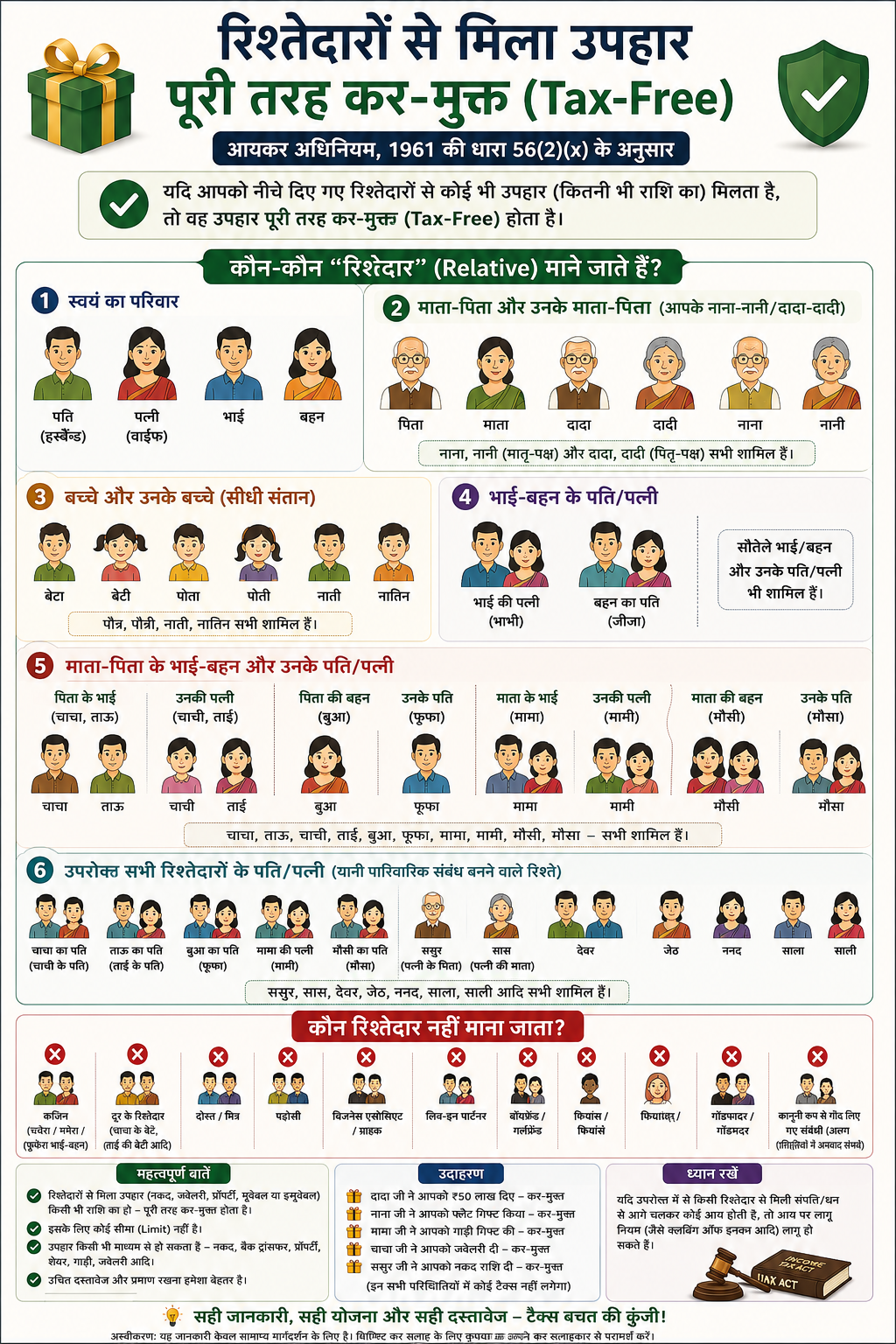
Instead of listing every relationship in this article, we have attached a detailed infographic that explains all the relatives covered under the law in a simple and easy-to-understand manner. The infographic includes relationships such as parents, grandparents (including both maternal and paternal grandparents), spouse, brothers, sisters, children, uncles, aunts, in-laws, and other qualifying relatives.
Please refer to the attached image for the complete list.
A Few Simple Examples
• Your father gifts you ₹20 lakh – No tax.
• Your grandmother gifts you a house – No tax.
• Your maternal grandfather (Nana) gifts you ₹5 lakh – No tax.
• Your uncle (Mama) gifts you a car – No tax, if he falls within the definition of a specified relative.
• Your friend gifts you ₹2 lakh – Taxable, since the gift is from a non-relative and exceeds the prescribed limit (unless another exemption applies).
Things to Remember
- There is no limit on the amount of gift you can receive from a specified relative.
- The exemption applies to cash, bank transfers, jewellery, shares, movable property and immovable property.
- Keep proper records such as bank statements, gift deeds (where appropriate), and supporting documents, especially for high-value gifts.
- If the gifted asset later generates income, other provisions of the Income Tax Act, such as clubbing of income, may apply.
Final Thoughts
Receiving a gift from a specified relative can be completely tax-free, but only if the relationship falls within the definition provided under the Income Tax Act. Since many people are confused about which relatives are covered, we have prepared a simple infographic explaining all the qualifying relationships.
Before accepting or giving a high-value gift, it is always advisable to understand the tax rules and maintain proper documentation. A little planning today can save unnecessary tax disputes tomorrow.
Disclaimer: This article is meant for general information only and should not be treated as legal or tax advice. Tax implications may vary depending on individual facts and circumstances.